Ever frozen mid-sentence, wondering about spend or spent? You’re not alone. It happens to everyone. This tiny choice trips up even confident writers. One wrong word can make a good sentence look sloppy. Trust me, it’s easier than it looks. So let’s fix the spend or spent problem for good.
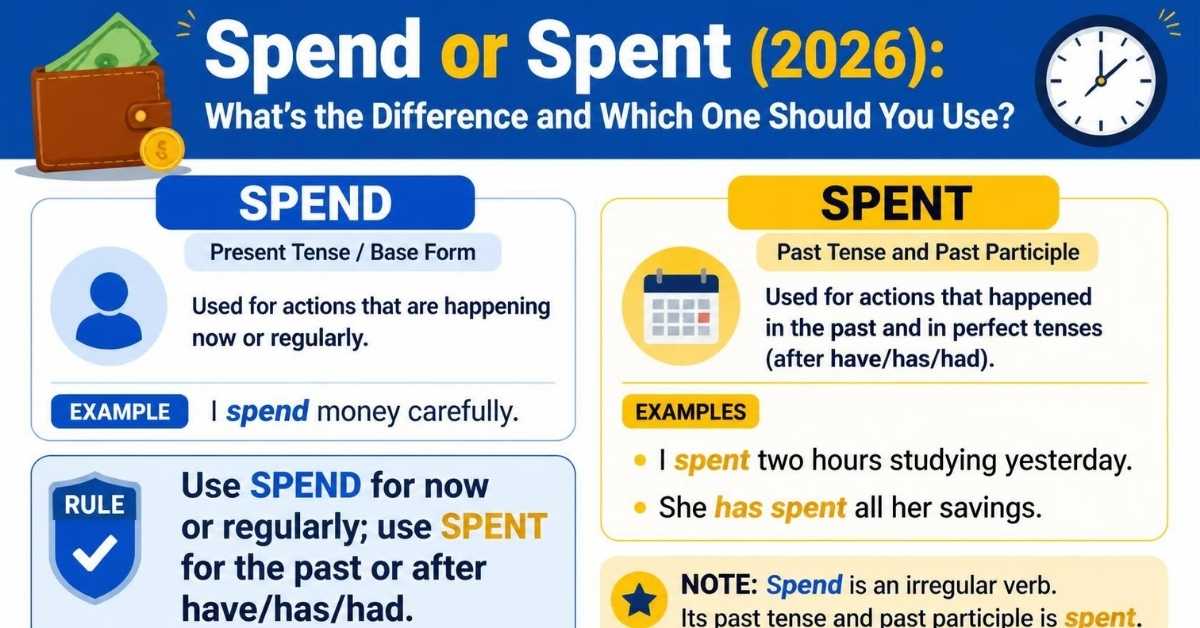
Here’s the quick answer to spend or spent. Let’s make it simple. Spend is for the present. Spent is for the past. You say, “I spend money every week.” You also say, “I spent money yesterday.” See the pattern? Spend or spent depends on time. If it’s happening now or often, pick spend. If it’s already done, pick spent. The spend past form is always spent. Never write “spended.” In this guide, you’ll learn easy rules, simple examples, and common mistakes. Let’s dive in. Ready to master spend or spent?
Quick Answer
Here’s the fast version of spend or spent. Keep it handy whenever you’re unsure.
- Spend = present tense (habits, routines, general facts)
- Spent = past tense and past participle (finished actions)
- Both words come from the same verb, to spend
- The spend past form is spent, never “spended”
Examples:
- I spend an hour reading every night.
- I spent an hour reading last night.
The spend past form works the same way for money, time, and effort.
One verb, two forms, and the clock decides which one you need.
Simple Background
Spend is one of those common English verbs you use without thinking. It means to use money, time, or energy.
It’s also one of the irregular verbs that skip the usual -ed ending.
Regular verbs follow a pattern, like walk and walked. Irregular verbs break the pattern, like spend and spent.
The spend past form looks a lot like its cousins send and sent, or bend and bent.
You’ll find this ending change in many irregular past tense verbs. English learners usually memorize them over time.
Think of them as old family traditions that never got updated.
Clear Explanation of the Difference
The spend vs spent question is really about timing. One word covers now and the other covers before.
Once you see that, the grammar rules feel almost too simple.
Spend
Spend is the present simple tense form. You use it for daily habits and routines and for general truths.
It also pairs with “will” for the future, as in “I will spend the weekend home.”
Check the spend meaning and spend definition in the Cambridge Dictionary.
It covers paying out money and passing time.
- I spend too much time on my phone.
- They spend weekends at their grandmother’s house.
- She spends her lunch break walking.
Notice the “s” in “spends.” Add it for he, she, and it.
Spent
Spent is the spend past form. It also works as the past participle, so it joins helping verbs like have, has, and had.
The spent meaning points to something already done.
You can compare the spent definition in Merriam-Webster.
It lists the past tense use and the adjective use.
- I spent all my cash yesterday.
- She spent three hours studying.
- They spent the weekend at the beach.
Comparison Table
Sometimes a table says it faster than a paragraph. Here’s the spend and spent comparison at a glance.
Screenshot it if you like.
| Feature | Spend | Spent |
| Verb type | Irregular verb | Irregular verb form |
| Tense | Present | Past and past participle |
| Meaning | Use money, time, or effort | Used money, time, or effort |
| Time clues | today, every day, usually | yesterday, last week, ago |
| Example | I spend money wisely. | I spent money yesterday. |
The spend past form sits in the right column. Everything finished belongs there.
Which One to Use and When
Knowing when to use spend and when to use spent comes down to three quick checks. Ask what time it is, what the action is, and whether a helper verb appears.
Let’s walk through each one.
Use “spend” when talking about the present
Pick spend for regular activities and habits. Watch for time expressions like every day, usually, and often.
These present tense examples show the pattern.
- I spend an hour exercising every morning.
- He spends a lot on books.
- We spend Sundays with family.
Use “spent” when talking about the past
Pick spent for completed actions. Time clues like yesterday, last month, and two years ago point straight to it.
These past tense examples make it clear.
- I spent an hour exercising yesterday.
- She spent a lot on books last month.
- We spent Sunday with family.
Use “spent” with helping verbs
Here’s where spent past participle use matters. Auxiliary verbs like have spent, has spent, and had spent always take spent.
“Have spend” is never correct.
- I have spent enough money this month.
- She has spent all her savings.
- They had spent the whole day working.
Spend Conjugation at a Glance
Seeing every form in one place helps spend conjugation stick. This chart covers the English verb forms you’ll need.
The spend past form appears twice because the simple past and the participle match.
| Form | Word | Example |
| Base form | spend | I spend my evenings reading. |
| Third person | spends | She spends her evenings reading. |
| Present participle | spending | He is spending too much. |
| Simple past | spent | They spent too much. |
| Past participle | spent | We have spent too much. |
Common Mistakes People Make
Even fluent speakers slip here. Here are the common grammar mistakes with spend and spent, each with a quick fix.
Spot the pattern once and you’ll catch it forever.
Mistake 1: Using “spend” for the past
- Wrong: I spend all my money yesterday.
- Right: I spent all my money yesterday.
The word “yesterday” is your alarm bell. It demands the spend past form.
Mistake 2: Using “spent” for the present
- Wrong: I spent a lot of time reading every day.
- Right: I spend a lot of time reading every day.
“Every day” signals a habit. Habits take the present tense of spend.
Mistake 3: Forgetting the irregular form
Learners sometimes build the past tense the regular way. That gives you “spended,” which isn’t a real word.
Always use spent as the spend past form.
- Wrong: She spended her bonus.
- Right: She spent her bonus.
Mistake 4: Mixing tenses
- Wrong: Last weekend I spend time with friends.
- Right: Last weekend I spent time with friends.
Keep the whole sentence in one time frame. A past time clue means a past verb.
Read Also: Fight Past Tense (2026)
Everyday Real-Life Examples
Rules feel easier when you see them at work. These spend or spent examples come from places you actually write and talk.
Read them out loud for extra practice.
In Emails
- I spent the morning reviewing your report.
- I spend most of my workday answering messages.
In News
- The city spent millions on the new bridge.
- Families spend more during holiday seasons.
On Social Media
- I spent all weekend watching movies.
- I spend way too much time scrolling.
In School
- Students spend hours preparing for exams.
- We spent the afternoon on our science project.
In Daily Conversations
- How much do you spend on groceries?
- I spent more than I planned.
Spend or Spent: Meaning, Money, Time, and More

Many people search very specific versions of this question. Let’s answer each one in plain words.
Think of this as the rapid fire round.
Spend or spent meaning
Spend means using money, time, or energy. Spent is the finished version of that action.
Spend or spent time together
Use spend for routines, like “We spend time together on Fridays.” Use spent for memories, like “We spent time together last summer.”
Spend or spent money
“I spend money on snacks” describes a habit. “I spent money on snacks” describes a purchase that already happened.
Both fit money management vocabulary, so the time clue picks the winner.
Spend or spent in a sentence
Try this pair: “I spend Saturdays hiking” and “I spent Saturday hiking.” The first is a pattern and the second is a single day.
Spend or spent grammar
The spend or spent grammar rule is simple. Present habits get spend and finished actions get spent.
Add a helping verb and spent takes over again.
Spend or spent examples
Here’s one for each tense: “She spends wisely.” “She spent wisely.” “She has spent wisely.” Same verb, three different timelines.
Spend or spent noun
Spend can also be a noun in business writing. For example, “The company tracks its monthly ad spend.” Spent isn’t used as a noun.
Spent or spend time with family
Say “I spend time with family every Sunday” for routine. Say “I spent time with family over the holidays” for a finished event.
Short Learning Section for Students and Beginners
New to English grammar? This section is built for English learners who want a fast win.
You only need a clock and two words.
Think About Time
Ask one question: when did it happen? If it’s now or happens regularly, pick spend.
If it already happened, pick spent.
Easy Formula
Here’s a trick for how to remember spend and spent.
- Today = spend
- Yesterday = spent
- Have, has, or had = spent
Practice Exercise
Try these grammar practice questions. Choose spend or spent.
- I always _____ Sunday mornings reading.
- She _____ all her savings last year.
- We _____ the afternoon at the park yesterday.
- They _____ too much time online every day.
- He has _____ his entire bonus.
- Do you _____ much on coffee?
Answer key: 1. spend, 2. spent, 3. spent, 4. spend, 5. spent, 6. spend
Spent as an Adjective
Here’s a fun twist. Spent can also describe things or people. As an adjective, it means used up or tired or exhausted.
- I felt completely spent after the marathon.
- She tossed the spent matches into the fire.
Context tells you which meaning you’re reading. If the sentence describes a feeling or an object, it’s the adjective.
FAQ’s
What is the past tense of spend?
The past tense of spend is spent. The spend past form stays the same for every subject, from I to they.
Is “spended” a word?
No. English doesn’t accept “spended” as a correct form. Use spent every time you need the spend past form.
When should I use spend and when should I use spent?
Use spend for habits, routines, and present facts. Use spent for completed actions and after helping verbs like have, has, and had.
Can spent be an adjective?
Yes. In “I feel spent,” it means tired or exhausted. In “spent fuel,” it means used up.
How can I remember the difference between spend and spent?
Think of it this way: today is spend and yesterday is spent. The spend past form always ends in “t,” which helps it stick.
Conclusion
The difference between spend and spent comes down to time. Spend covers the present tense for habits and routines, while spent covers the simple past tense and the past participle with helping verbs like have, has, and had. Once you know the spend past form, the confusion fades fast.
Skip “spended” and you’ll dodge the most common slip in English grammar. Which sentence tripped you up the most? Drop it in the comments and share this guide with a friend who’s learning English.

Reyansh is a passionate English language and grammar writer who enjoys making grammar, spelling, vocabulary, and writing concepts simple and easy to understand. With a focus on clear explanations and practical examples, Reyansh creates helpful content for students, writers, and everyday English learners. His goal is to make learning English more enjoyable, useful, and accessible to everyone.