You’re mid-sentence, fingers hovering over the keyboard. Is it “fighted,” “faught,” or something else entirely?
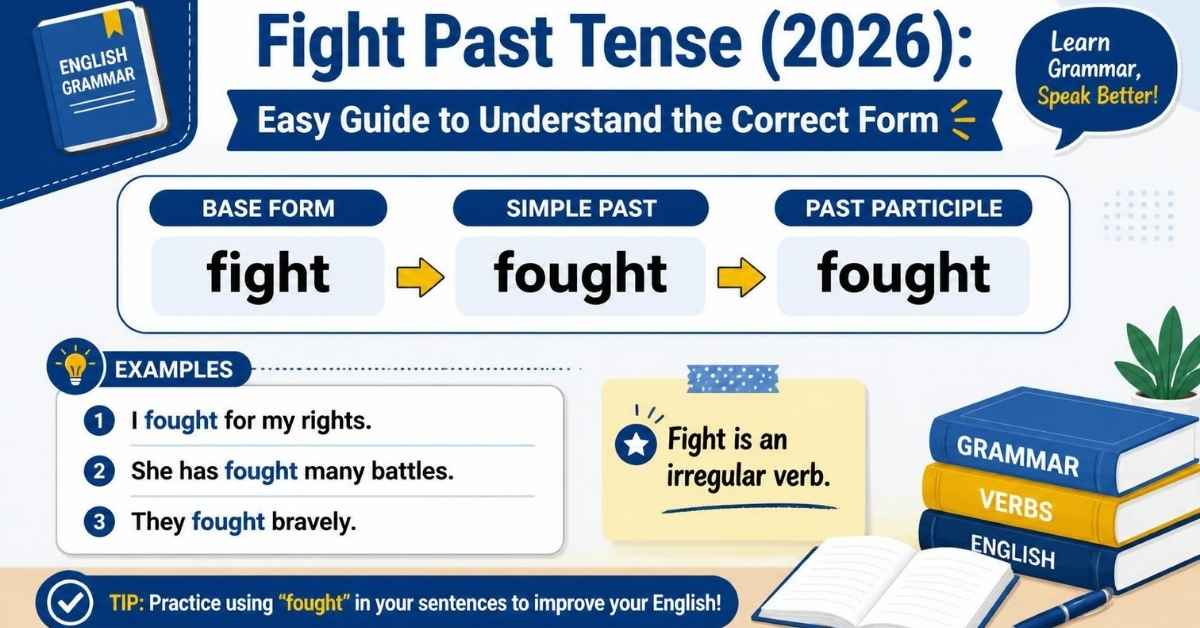
What is the past tense of fight? It’s fought. That’s the fight past tense you want, and it also works as the past participle after has, have, had. So “They fought yesterday” and “She has fought hard” are both correct.
Skip fighted and faught. Neither belongs in standard English, so the fought or faught debate ends here.
Why does this trip so many people up? Fight is an irregular verb, so it ignores the usual “ed” rule. The past tense fight form looks nothing like the original.
Stick around, because this 2026 guide covers meaning, pronunciation, real examples, and quick memory tricks. By the end, you’ll never second-guess this verb again.
Quick Answer
The fight past tense is fought. Say “He fought hard yesterday,” not “He fighted hard.”
Not sure about fought or faught? Go with fought. “Faught” isn’t a word in standard English, and no dictionary lists it.
Here’s the whole verb forms set in one glance:
- Base form: fight
- Past tense: fought
- Past participle: fought
- Present participle: fighting
Simple Background
Fight belongs to a family of irregular verbs. These verbs ignore the usual “add ed” rule that most English grammar lessons teach first. Instead, they change the vowel or the whole word.
So why does this happen? Old English had a verb, feohtan, and its forms shifted over centuries. The spelling kept its silent “gh,” and the sound drifted into what you say today.
Think of it like a family recipe that got changed by every cook. Nobody wrote down the original, so the result looks odd. That’s why English learners hit a wall here.
Clear Explanation of the Difference
Let’s break down fight vs fought without the textbook voice. One describes what’s happening or what usually happens. The other describes something that’s already over.
Once you see them side by side, the fight and fought difference feels small. It’s really just a question of timing.
What is “Fight”?
Fight is the base form. It’s the present tense version you use for habits, facts, and things happening now. Examples: “I fight for my team every game,” and “Cats fight over food.”
The fight meaning has a few layers. It can mean a physical struggle, a heated argument, or an effort to achieve something. So “fight for justice” and “fight a cold” both work.
Add an “s” for he, she, and it: “She fights.” That’s the only change in fight in present tense.
What is “Fought”?
Fought is the past tense and the past participle. Use it for past actions that are finished. Fought in past tense looks like this: “They fought yesterday.”
The fought meaning is the same as fight, only moved into the past. It tells us the struggle, argument, or effort already happened. Nothing about the meaning changes, just the time.
Here’s a quick fought in a sentence example: “My grandfather fought in a war and rarely talked about it.” Simple, clear, and finished.
Comparison Table
Sometimes a table beats a paragraph. Here’s the fight vs fought breakdown in one place.
| Feature | Fight | Fought |
| Form | Base form | Past tense and past participle |
| Time | Present or general | Past |
| Example | I fight for fairness. | I fought for fairness. |
| With helper verb | will fight, can fight | has fought, had fought |
| Common error | Using it for past events | Spelling it “faught” |
Notice that fought works alone and after a helper. That makes it easier than verbs with two different past forms, like “go, went, gone.”
Which One to Use and When
Ask one question: did it already happen? If yes, use fought. If it’s happening now, or it happens regularly, use fight.
Look for clue words too. “Yesterday,” “last week,” “in 2019,” and “years ago” all point to the past.
Here are a few quick matches:
- Fought yesterday: “We fought yesterday, but we made up.”
- They fought often: “They fought often when they were kids.”
- Fight for my team: “I fight for my team every Saturday.”
Simple Tip to Remember
Try this trick: fought rhymes with taught, bought, thought, and caught. These verbs all follow the same pattern. If you can say “I taught,” you can say “I fought.”
Picture a boxer who just bought a ticket and thought about fighting. Silly, yes. But silly sticks.
Common Mistakes People Make
Even strong writers slip here. These are the common grammar mistakes I see most, and each is easy to fix. Let’s walk through them.
1. Saying “fighted”
Wrong: “She fighted the whole day.” Right: “She fought the whole day.”
So, is fighted a word? Not in standard English. Some kids say it while learning to talk, and it’s actually a sign they’ve learned the “ed” rule. So is fighted correct? No, but the instinct behind it makes sense.
2. Using present tense for past actions
Wrong: “Yesterday, we fight about money.” Right: “Yesterday, we fought about money.”
This one sneaks in during fast typing. Your brain knows the story is old, but your fingers grab the base form. Always scan for time words and check the verb.
3. Forgetting irregular verb patterns
Wrong: “He has fight many battles.” Right: “He has fought many battles.”
After has, have, or had, you need the past participle. Since fight is irregular, the base form won’t work there. That’s one of the key grammar rules to lock in.
Everyday Real Life Examples
Rules feel dry until you see them in real situations. So here are everyday English examples from four places you actually live.
Read them aloud. You’ll hear how natural fought sounds.
In School
“The two friends fought over a borrowed pencil, then laughed about it.” Kids use this verb a lot, so it’s a great one to teach early. Another: “Our class fought for a longer lunch break.”
In Sports
“The underdogs fought until the final whistle.” In sports talk, fought describes effort and grit. Another: “She has fought through three injuries this season.” Notice has fought there, a perfect tense.
In Movies
“The hero fought off the villain on a moving train.” Movie reviews use fought constantly. Another: “In the sequel, he fought his own fears.” That’s a good example of the figurative meaning.
In Daily Life
“I fought with his brother over the TV remote,” is wrong, so fix the pronoun: “I fought with my brother over the TV remote.” Or: “She fought back tears at the airport.” Daily life gives you plenty of examples of fought in sentences.
Short Learning Section for Students
Studying English language learning shouldn’t feel like punishment. Four small steps will get you there. Take them one at a time.
Read More: https://weblyzeto.com/
Step 1: Learn the forms
Write all three forms on a sticky note: fight, fought, fought. Stick it on your desk or mirror. Seeing it daily beats cramming once.
Step 2: Practice
Fill in the blanks. Try these:
- Last night, the dogs ______ over a bone. (fought)
- She has ______ for this job for years. (fought)
- Right now, they ______ for first place. (fight)
Step 3: Use memory trick
Link fought to thought and caught. Say all three in a row. Your ear will start to expect the “ought” ending.
Step 4: Practice speaking aloud
Make up three sentences about your day and say them out loud. Use fought at least once. Speaking locks in verb conjugation better than silent reading.
Fight past tense sentence
Need a model? Try these: “The firefighters fought the blaze all night.” “We fought traffic to get here.” Each one shows a finished action, so fought fits.
Fight past tense meaning
The fight past tense meaning is simple. It tells us someone struggled, argued, or battled at an earlier time. The action is over, even if the effects linger.
How to pronounce fight past tense
Say fought like “fot” with a longer “aw” sound. It rhymes with bought and taught. The “gh” stays silent, just like in “fight.”
Fight past perfect tense
The fight past perfect tense is had fought. You use it when one past action happened before another. For example: “By the time I arrived, they had fought and made up.”
The perfect tenses use has, have, had plus fought. Present perfect: “She has fought.” Past perfect: “She had fought.” Future perfect: “She will have fought.”
Find past tense
While you’re on irregular verbs in English, here’s a bonus. The past tense of find is found. Example: “I found my keys in the freezer.”
Fly past tense
Another favorite for English learners is fly. Its past tense is flew, and its past participle is flown. So: “The bird flew away,” and “It has flown south.”
Notice that fly has two different past forms, unlike fight. That’s why fight is a bit kinder to learn.
Fight past tense pronunciation
For fight past tense pronunciation, remember that British and American speakers differ slightly. British English usually says /fɔːt/. American English can say /fɔt/ or /fɑt/ depending on region.
Both are right. Pick the one that matches your accent and stay consistent.
Fought pronunciation
Here’s the quick fought pronunciation drill. Say it five times: “fought, fought, fought, fought, fought.” Then pair it with a rhyme: “fought, caught, taught.”
If you want to check yourself, record your voice and compare it with an online dictionary audio clip.
Fight Conjugation in English
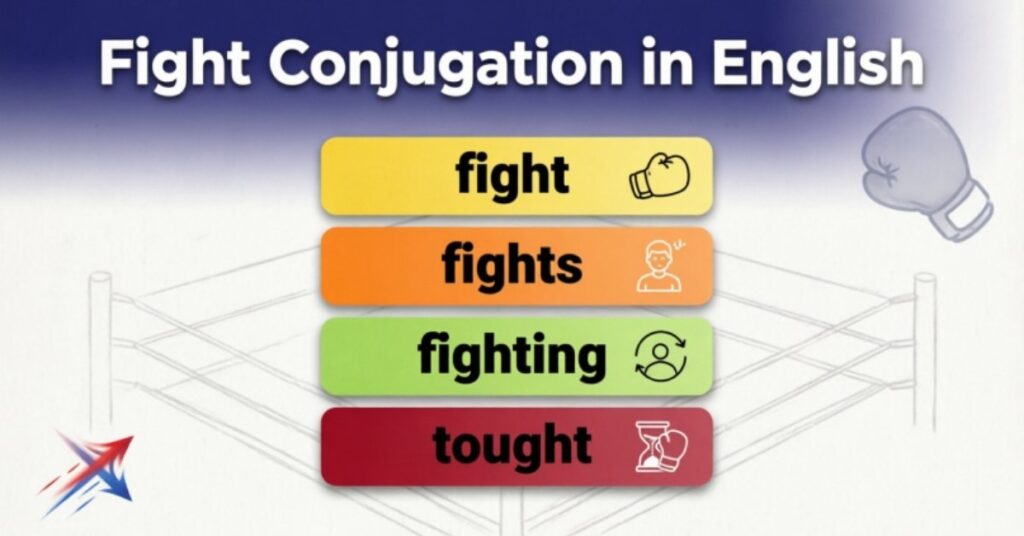
You’ve seen the past. Now see the full fight conjugation in English across English verb tenses. This helps you spot where fought belongs and where it doesn’t.
| Tense | Example |
| Simple present | I fight |
| Present continuous | I am fighting |
| Simple past | I fought |
| Present perfect | I have fought |
| Past perfect | I had fought |
| Future | I will fight |
Look closely and you’ll spot a pattern. Fought appears twice by itself and twice with a helper. The rest uses fight or fighting.
Fight Synonyms: Battle, Argue, and Struggle
Variety keeps your writing fresh. So here are some fight synonyms to swap in. Each one carries a slightly different feel.
- Battle: large, serious, often with a clear opponent
- Argue: a verbal clash, usually about opinions
- Struggle: a hard effort, even without an opponent
- Clash: a sudden, sharp conflict
Past forms matter here too. “Battle” is regular, so you get battled. “Argue” gives argued. “Struggle” gives struggled. Only fight stays irregular.
Past Tense Practice Exercises
Ready for a quick quiz? These past tense practice exercises take about two minutes. Answers sit below.
- Yesterday, my cousins ______ about who sat in front. (fight)
- He has ______ many battles in court. (fight)
- They ______ for justice for decades. (fight)
- We ______ the urge to laugh in class. (fight)
Answers: 1. fought, 2. fought, 3. fought, 4. fought.
Fun twist: every answer is fought. That’s the beauty of this verb. Once you know one form, you’ve nailed both.
Why English Learners Find This Confusing
Most people learn the “ed” rule first. So their brain tries it everywhere. That’s normal, not a sign you’re bad at English.
Also, the spelling doesn’t match the sound. “Fight” and “fought” don’t look alike, and the “gh” is silent in both. That mismatch trips up almost everyone.
The fix is repetition, not memorizing a rulebook. Short daily practice beats long weekend sessions. Aim for five minutes a day.
FAQ’s
What is the past tense of “fight”?
The past tense of fight is fought. Use it for any finished action, like “They fought last night.”
Is “fighted” correct?
No, fighted isn’t correct in standard English. Always say fought instead.
Is “fight” a regular verb?
No, fight is an irregular verb. It doesn’t add “ed” to form the past tense.
Is “fought” also a past participle?
Yes, fought works as both the simple past and the past participle. You’ll use it after has, have, had, like “She has fought hard.”
How can I remember the correct form easily?
Link fought with taught, bought, and caught. They share the same ending sound, so say them together a few times.
Conclusion
So, what is the past tense of fight? It’s fought, and it works as both the simple past and the past participle. You’ll never need fighted or faught again.
Keep the rule simple. Use fight for now or habits, and fought for anything that’s already over. After has, have, had, stick with fought too.
Memory tricks help here. Link fought to taught, bought, and caught, then say them out loud a few times. Five minutes of daily practice beats one long study session.
Now it’s your turn. Which irregular verb still trips you up? Drop it in the comments, and share this guide with a friend who’s still stuck on fought or faught.

Reyansh is a passionate English language and grammar writer who enjoys making grammar, spelling, vocabulary, and writing concepts simple and easy to understand. With a focus on clear explanations and practical examples, Reyansh creates helpful content for students, writers, and everyday English learners. His goal is to make learning English more enjoyable, useful, and accessible to everyone.