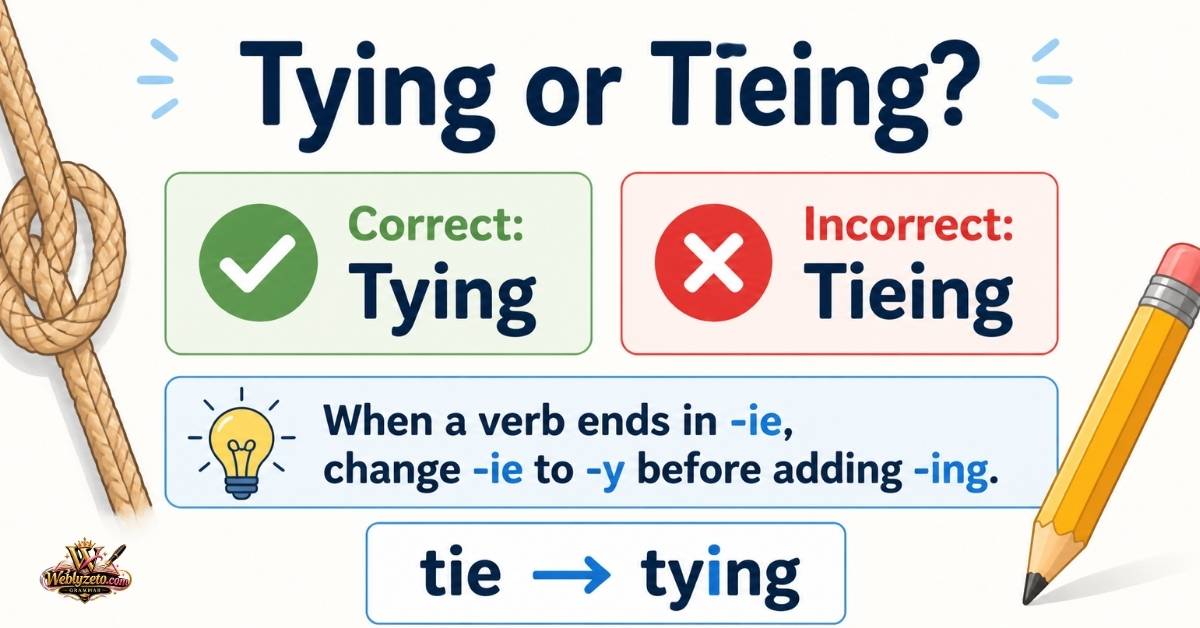
When writing in English, small spelling mistakes can make you stop and think. You might wonder whether to write “tying” or “tieing” in a sentence. Both forms may look correct, but only one follows standard English spelling rules. The correct spelling is tying. It comes from the verb “tie,” which means to fasten or secure something.
You use this word in everyday situations, such as tying your shoes, tying a ribbon, or tying a knot. The spelling rule is simple once you understand it. When a verb ends in “ie,” change those letters to “y” before adding “ing.” For example, “die” becomes “dying,” and “lie” becomes “lying.” This guide explains Tying or Tieing with clear examples, simple grammar tips, and common mistakes to avoid.
What Are You Looking For?
Are you unsure whether to write tying or tieing in an email, school assignment, or social media post? You’re not alone, because the spelling looks unusual when you first see it.
The correct spelling is tying, not tieing. Whether you’re talking about tying your shoes, making a knot, or fastening a ribbon, the same English spelling rules apply. Once you understand why the final letters change, you can use this word confidently in everyday writing.
Quick Answer
Tying is the correct spelling of the verb tie when you add -ing. The final -ie changes to y before the suffix, giving you tie → tying.
For example, you would write, “I’m tying my shoelaces before leaving home.” Writing “I’m tieing my shoelaces” is a spelling mistake in standard English. The rule also applies to words such as die and lie, which become dying and lying.
Simple Background: Where Does “Tying” Come From?
The word tying comes from the base verb tie, which means to fasten, secure, or connect something. You might use it when fastening a rope, tying a bow, or securing two objects together.
When English speakers add -ing to this verb, they follow a familiar spelling pattern for verbs ending in -ie. The letters change before the suffix, so the result is tying rather than tieing. Understanding this pattern makes other verb forms easier to spell correctly.
Clear Explanation of the Difference
The difference between tying vs tieing is straightforward. One follows standard English spelling rules, while the other is considered incorrect in ordinary modern English writing.
Both forms may look understandable to a reader, but that doesn’t make them equally acceptable. If you’re writing an essay, an email, a website article, or a professional document, choose tying.
1. Tying (Correct)
Tying is the standard form of tie with the -ing ending. It can describe an action happening now or an activity discussed as a concept.
For example, “She is tying a ribbon around the gift” describes an action in progress. In the sentence “Tying a knot takes practice,” the word tying names an activity. Both examples use the correct spelling of tying.
2. Tieing (Incorrect)
Tieing is a nonstandard spelling that results from adding -ing without changing the original -ie ending. It may seem logical if you apply the usual pattern of simply adding -ing to a verb.
However, English spelling rules don’t treat every verb in exactly the same way. For verbs ending in -ie, the standard pattern changes -ie to y before adding -ing. Therefore, tieing should be avoided in standard writing.
Comparison Table
The following table shows how the correct form differs from the common spelling error and how the same rule works with related verbs.
| Base Verb | Correct -ing Form | Incorrect Form |
| Tie | Tying | Tieing |
| Die | Dying | Dieing |
| Lie | Lying | Lieing |
Notice the pattern in all three examples. The ending -ie changes to y before -ing is added.
Remember that trying is different because it comes from the verb try, not tie. Both trying and tying are correct words, but they have different meanings and spellings.
Read More: Naive or Nieve (2026): Easy Guide to Understand the Difference
Which One Should You Use and When?
Use tying whenever you need the -ing form of the verb tie. The word works in different grammatical situations, so you don’t need a separate spelling for formal or informal writing.
For example, you might write about tying a rope in a school assignment or mention tying your hair back in a casual message. The spelling stays the same in both cases.
Present Continuous Tense
The present continuous tense describes an action happening now or around the current period. It uses a form of be followed by a verb ending in -ing.
For example, “He is tying his shoes” describes an action in progress. You could also say, “They are tying balloons for the birthday party.” In both sentences, tying is the present participle of tie.
As a Gerund (Verb Acting Like a Noun)
A gerund is a verb ending in -ing that functions as a noun. It can name an activity rather than describe an action someone is currently performing.
For example, “Tying knots requires patience” treats the activity as the subject of the sentence. Similarly, “She enjoys tying ribbons” uses tying after the verb enjoys. The spelling remains unchanged because both examples use the same -ing form.
Why Does the Spelling Change?
The tying spelling rule follows a common pattern for verbs ending in -ie. When you add -ing, replace the final -ie with y, then attach the suffix.
Here is the process in a simple form:
- Tie becomes tying.
- Die becomes dying.
- Lie becomes lying.
This pattern helps keep written forms consistent and avoids awkward combinations of letters. Although English has plenty of spelling exceptions, this particular rule is easy to remember once you’ve practiced it.
Common Mistakes People Make
Many spelling errors happen because writers apply one familiar rule to every verb. The problem becomes easier to avoid when you recognize the specific pattern used by words ending in -ie.
Here are four common mistakes and how to correct them.
Mistake 1: Writing “Tieing”
The first mistake is adding -ing directly to tie. This produces tieing, which isn’t the standard spelling.
Instead, replace -ie with y before adding the suffix. Write “I am tying a knot,” not “I am tieing a knot.”
Mistake 2: Forgetting the -ie Rule
Some learners remember that verbs often take -ing without changing their spelling. However, that pattern doesn’t cover every verb in English.
When a verb ends in -ie, use the special spelling pattern. For example, lie becomes lying, and die becomes dying. Remembering these examples makes the rule easier to apply.
Mistake 3: Thinking Both Spellings Are Acceptable
Because tieing looks logical, some writers assume it’s an alternative spelling. In standard modern English, however, tying is the accepted form.
This distinction matters in formal writing, including examinations, reports, applications, and published articles. Using the standard spelling helps you communicate clearly and avoid unnecessary errors.
Mistake 4: Mixing Up with “Trying”
The words trying and tying look similar, but they come from different base verbs. Trying comes from try, meaning to attempt something, while tying comes from tie, meaning to fasten or connect.
Compare these examples: “I’m trying to learn English” and “I’m tying my shoes.” The first describes an attempt, while the second describes fastening something. Their meanings determine which word you need.
Everyday Real-Life Examples
You can use tying in many ordinary situations. It describes fastening objects, securing materials, or even making a game score equal.
The meaning depends on the surrounding words. These examples show how to use tying in a sentence naturally.
In Emails
Suppose you’re sending a message to a colleague about preparing an event. You might write, “I’m tying the decorations together before the guests arrive.”
You could also say, “We’re tying up the final details before the meeting.” This second example uses a common expression meaning to finish or settle outstanding matters. In both cases, tying is spelled the same way.
On Social Media
People often use tying when sharing pictures or short updates about everyday activities. A caption might say, “Finally learned how to tie a bow without help!”
Another post could read, “Tying my shoes and heading out for a morning walk.” These examples sound natural and demonstrate the correct spelling without making the caption unnecessarily complicated.
In News or Articles
Writers may use tying when describing a sports result or a connection between events. For example, “The team is tying the score in the final minutes of the match.”
In this context, tying means bringing the scores level. A writer might also describe an investigation as tying two events together, meaning the evidence connects them. The intended meaning comes from the context, not a different spelling.
In Daily Conversation
Imagine someone asks what you’re doing before leaving the house. You might answer, “I’m tying my shoelaces.”
If you’re preparing a present, you could say, “I’m tying a ribbon around the box.” You might also use the word when fastening a rope, securing balloons, or tying your hair back. Each example follows the same spelling pattern.
Additional Examples of Tying in Different Contexts

The word tying has more than one everyday use. It can describe physically fastening something or creating a connection between ideas, events, or results.
Consider these examples:
- “She is tying the rope around the wooden post.”
- “He is tying his tie before work.”
- “We spent the afternoon tying balloons for the celebration.”
- “The final goal is tying the match at two goals each.”
- “The report is tying the evidence to the main finding.”
These sentences show why context matters when learning vocabulary. Although the action changes, the spelling of tying doesn’t.
Short Learning Section for Students and Beginners
If you often forget how to spell tying, use a simple four-step method. It works for this word and helps you remember the spelling pattern for other verbs ending in -ie.
Practice the steps whenever you write a new verb form. With repetition, the correct spelling becomes easier to recognize.
Step 1: Look at the Verb
Start with the base verb, which is the original form of the word. In this case, the verb is tie.
Ask yourself what action the word describes. If you’re talking about fastening something, connecting objects, or making a knot, tie is the right starting point.
Step 2: Does It End in -ie?
Look at the final two letters of the verb. The word tie ends in -ie, which signals that you need the relevant spelling rule.
This step helps you distinguish tie from verbs that follow different patterns. Checking the ending first prevents you from automatically adding -ing to every verb.
Step 3: Remove -ie
Take away the final -ie from tie. You’re left with the letter t.
It might look strange at first, but this is only an intermediate step. Don’t try to pronounce the shortened form as a complete word.
Step 4: Add Y + ING
Replace the removed -ie with y, then add -ing. The result is tying.
You can remember the pattern as tie → tying. Practice it alongside die → dying and lie → lying to reinforce the rule.
Tying vs Trying: What’s the Difference?
Although these words look similar, they have different meanings and come from different base verbs. Understanding that difference helps you choose the right word when writing quickly.
Tying describes fastening, connecting, or bringing scores level. Trying describes making an attempt, testing something, or experiencing difficulty, depending on the context.
For example, “She is tying a ribbon” describes fastening a ribbon. “She is trying to tie a ribbon” means she’s attempting to do it. Both words are correct in their own contexts, but they aren’t interchangeable.
FAQ’s
Is tieing ever correct?
No, tieing is considered incorrect in standard English.
Tying or Tieing has one correct spelling: tying.
Why does tie become tying?
Tie ends in ie, which changes to y before adding ing.
This spelling rule gives us tying, not tieing.
Is tying used in formal writing?
Yes, tying is correct in formal and informal writing.
Use it in essays, emails, reports, and everyday messages.
Does the ie rule apply to other verbs?
Yes, verbs like die and lie follow the same pattern.
They become dying and lying when you add ing.
Why can’t you write tieing?
Standard English replaces ie with y before adding ing.
That is why tying is correct and tieing is incorrect.
How can I remember the spelling of tying?
Remember the simple pattern: tie becomes tying.
The Tying or Tieing spelling rule makes the correct form easy to remember.
What does tying mean?
Tying means fastening or securing something with string, rope, or similar material.
It can also mean bringing a score level.
Is tying pronounced differently from tieing?
Tying is the accepted spelling in standard English.
Tieing is nonstandard, so use tying in your writing.
Conclusion
Tying or Tieing can be confusing when you are learning English, but the correct spelling is simple to remember. Tying is the correct form, while tieing is a spelling mistake in standard English. When a verb ends in ie, change ie to y before adding ing. For example, tie becomes tying, die becomes dying, and lie becomes lying. This small rule can help you avoid common spelling errors.
Whenever you write about tying your shoes, tying a knot, or tying a ribbon, use the correct spelling. If you are unsure about Tying or Tieing, remember that tying follows the standard English spelling rule. Practice with simple examples to make the rule easier to remember. Using the right spelling makes your writing clearer and more accurate. Now, you can confidently choose tying in your schoolwork, emails, articles, and everyday conversations.

Reyansh is a passionate English language and grammar writer who enjoys making grammar, spelling, vocabulary, and writing concepts simple and easy to understand. With a focus on clear explanations and practical examples, Reyansh creates helpful content for students, writers, and everyday English learners. His goal is to make learning English more enjoyable, useful, and accessible to everyone.