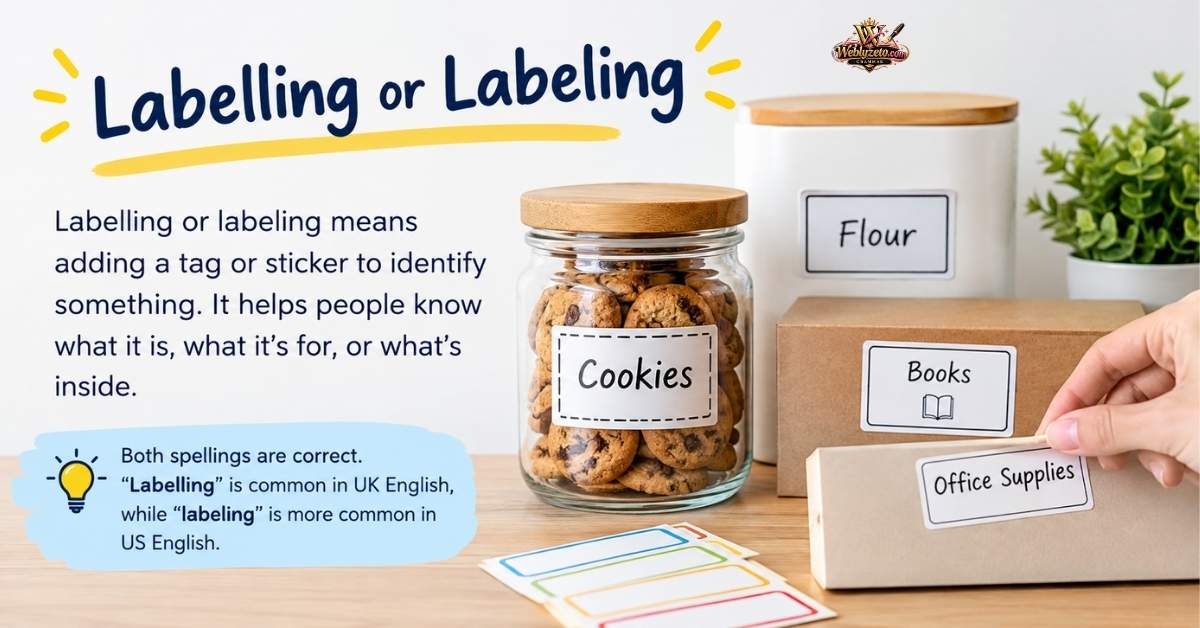
Ever stopped mid-sentence and thought, “Is it labelling or labeling?” You’re not alone. Many people pause at this exact word. Your spell checker might flag one. Your teacher might circle the other. So which one is right? Don’t worry about it. It’s a small spelling puzzle, and it has a simple fix. One extra letter L is all that separates the two words. Yet that tiny letter confuses writers, students, and even editors every day.
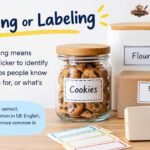
Here’s the quick answer. Labelling is British English. Labeling is American English. Both are correct. The meaning is the same. Only the spelling changes. Choosing between labelling or labeling depends on your reader. In this guide, you’ll learn the simple rule behind labelling or labeling. You’ll also see examples, common mistakes, and easy tricks. Let’s clear up labelling or labeling once and for all.
Quick Answer
Labelling has a double L and belongs to British English. Labeling has a single L and belongs to American English.
The meaning doesn’t change at all. Only the spelling style does.
So when someone asks “which spelling is correct,” the honest reply is “it depends on where your reader lives.” A reader in London expects two Ls. A reader in Chicago expects one.
Simple Origin and Background
The word comes from the noun label, which started life as a small strip of cloth or paper. Over time it became a verb too. When you add -ing to it, you get the present participle.
That’s where the trouble starts. English has no single rule for adding -ing to words that end in L. British English and American English went separate ways on this.
Noah Webster pushed American spelling toward simpler forms in the early 1800s. He wanted fewer extra letters. As a result, many double consonants shrank to one in the US, while Britain kept them.
Clear Explanation of the Difference
Think of it like two neighbors who paint the same fence. One adds an extra coat, and the other stops after one. The fence is the same, but the finish looks different.
Here’s how each side handles it.
Labelling (British English)
British English doubles the final L before a suffix. It does this even when the stress sits on the first syllable. That’s why you see labelling and labelled.
The same British double L rule gives you travelling, cancelling, and modelling. Once you spot the pattern, it’s easy to apply to every word ending in L.
You’ll see labelling across the UK, Australia, New Zealand, India, and South Africa. Canada also leans toward the double L in most formal writing.
Labeling (American English)
American English follows a stress rule. It only doubles the final consonant when the stress falls on the last syllable. In label, the stress falls on the first syllable, so the L stays single.
That’s the American single L rule at work. It explains labeling, labeled, traveling, canceling, and modeling.
Compare that with a word like compel. The stress lands on the last syllable, so Americans write compelled with two Ls. The rule is consistent once you know where to look.
Comparison Table
Here’s the quick side-by-side. Bookmark it if you write for both audiences.
| Feature | Labelling | Labeling |
| Spelling style | British spelling | American spelling |
| Number of Ls | Double L | Single L |
| Past tense | Labelled | Labeled |
| Used in | UK, Australia, India, NZ | US |
| Pronunciation | LAY-buh-ling | LAY-buh-ling |
| Meaning | Same | Same |
Notice that the word pronunciation is identical. You can’t hear the difference in speech. You only see it on the page.
Which One to Use and When
Your choice should follow your reader, not your gut. Ask yourself who will open this page, email, or document.
If you pick one and keep it throughout, you’re doing it right. Readers forgive either spelling. They don’t forgive a mix.
Use “Labelling” When Writing in British English
Use labelling if your audience is in the UK, Australia, New Zealand, India, or South Africa. Also use it when your style guide says British.
Think of a UK food company writing about ingredients. You’d see “allergen labelling rules” on their site. A British editor would flag “labeling” as a slip.
Use “Labeling” When Writing in American English
Use labeling if you write for US readers. That covers US schools, US brands, and most American publishers.
A US pharmacy, for instance, talks about “prescription labeling.” If it printed “labelling,” customers would notice something felt off.
What to Do If You Are Unsure
Check your tools first. Look at your word processor’s language setting, your company style guide, or your client’s website.
Still stuck? Choose the spelling your audience sees every day. Then run one search for the other form to make sure you didn’t mix them. A quick find and replace takes ten seconds.
Labeled or Labelled: Past Tense Made Simple
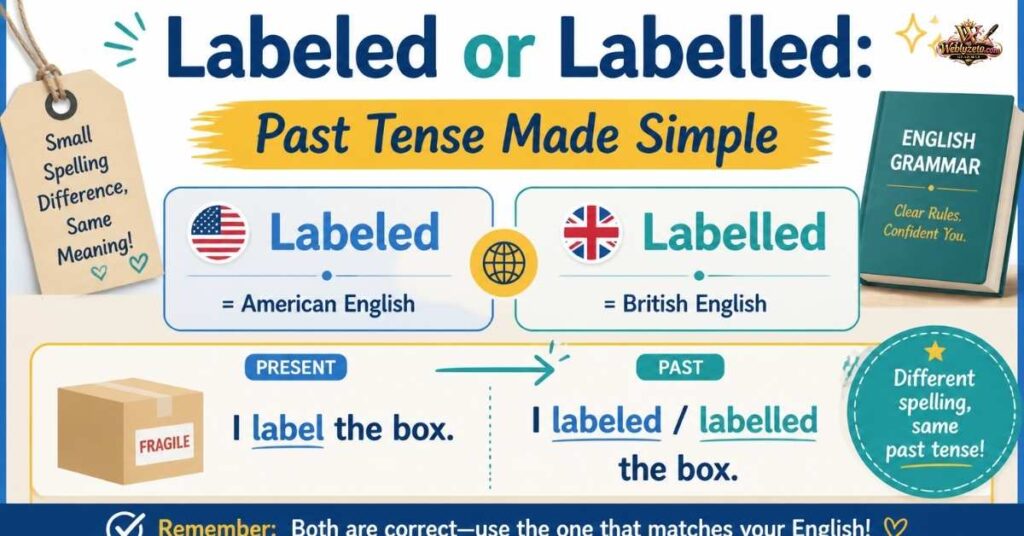
The same split shows up in the label past tense. Labelled is British, and labeled is American. The pattern matches labelling vs labeling exactly.
So the rule is simple. If you write labelling, you write labelled. If you write labeling, you write labeled.
Here’s where people trip up. They’ll use labelled vs labeled in one paragraph, then switch halfway down. Don’t do that. Keep the pair matched, and your spelling consistency stays clean.
Read More:Feed vs Fed (2026): Easy Guide to Understand the Difference
Common Mistakes People Make
Most errors aren’t about knowledge. They come from rushing. Let’s walk through the four that pop up most.
Mixing Both Spellings
This is the biggest one. A writer uses “labeling” in the intro and “labelled” in the conclusion.
It looks sloppy. Search engines and editors both prefer spelling consistency inside a single piece.
Thinking One Spelling Is Wrong
Many learners ask, “is labeling correct?” or “is labelling correct?” Both are correct in their own region.
Marking one as an error is a common spelling mistake in itself. Teachers and editors do it too, so don’t feel bad.
Adding Too Many Letters
Some people write “labbelling” or “labellling.” Extra letters sneak in when you type fast.
The double L stops at two. Never three. If it looks odd, retype the word slowly.
Forgetting the Base Word
Always return to the base word label. Ask yourself, “What do I get when I add a suffix?”
Label plus -ing gives labeling or labelling. Label plus -ed gives labeled or labelled. Thinking in pieces prevents most common spelling errors.
Everyday Real-Life Examples
Rules feel dry until you see them in use. Here are everyday examples of how each spelling appears.
In Emails
Picture a manager writing to a supplier. “Please confirm the labelling on the new batch before shipping.” That reads naturally in a UK office.
Now picture a US office. “Please confirm the labeling on the new batch before shipping.” Same sentence, different spelling.
In News Articles
British papers write about “food labelling changes” and “clear labelling on packaging.” You’ll see labelled in headlines too.
American outlets run stories on “nutrition labeling” and “products labeled organic.” Every outlet follows its own house style.
On Social Media
Social posts are messier. People type fast, so you’ll see both forms. A UK user might post, “I spent the weekend labelling my pantry jars.”
A US user might say, “Just finished labeling all my storage boxes.” Neither is wrong, and nobody is checking.
In Daily Conversations
You can’t hear the difference when you speak. “I’m labeling the folders” and “I’m labelling the folders” sound identical.
That’s why the confusion only appears when you write. Speech hides it, and spelling exposes it.
Label Meaning: Noun and Verb
Let’s clear up the label meaning. As a noun, a label is a tag or piece of text that identifies something. Think of a clothing tag or a food package.
As a verb, to label means to attach that tag, or to describe something with a word. You might label a box, or you might label a person unfairly.
So yes, label as a noun and label as a verb both work. The labeling meaning in English and the labelling meaning in English come from the verb form. They describe the act of adding a label.
Other Words That Follow the Same Pattern
Once you understand this, you can handle a whole group of words. They all share the same spelling patterns.
Take traveling vs travelling. Americans write “traveling” and Brits write “travelling.” Same story with canceling vs cancelling and modeling vs modelling.
Other words work the same way:
- Counsel: counseling (US), counselling (UK)
- Level: leveled (US), levelled (UK)
- Signal: signaling (US), signalling (UK)
- Fuel: fueling (US), fuelling (UK)
Learn the rule once, and you’ve fixed dozens of spelling variations in English at the same time. That’s a good return on five minutes.
Short Learning Section for Students and Beginners
If you’re one of the English learners reading this, relax. This is a small difference, and you can master it fast. A few simple tools will help.
Memory Trick
Here’s one that works. British and double both start with letters that feel “bigger,” so picture Britain adding an extra L for good measure.
Or think “American means Alone.” One L stands alone in labeling. It’s silly, but it sticks.
Quick Practice
Try these. Fill in each blank with the right spelling for the style shown.
- (British) She is ______ every jar in the kitchen.
- (American) He ______ the boxes before the move.
- (British) The shop got fined for poor food ______.
- (American) The ______ on the bottle was unclear.
Answers: 1. labelling, 2. labeled, 3. labelling, 4. labeling. Count how many you got right. Four out of four means you’ve got it.
Simple Tip
Match your spelling to your spell check language setting. Change it to UK or US English before you start writing. Your software will flag mistakes automatically.
Then read your finished piece once for correct word usage. It’s a small habit with big results.
Example Sentences You Can Borrow
Sometimes you just want sentences to copy. Here are some labeling examples in sentences for American readers:
- The labeling on this bottle lists every ingredient.
- We labeled each file by date.
- Proper labeling saves time in a busy warehouse.
And here are some labelling examples in sentences for British readers:
- The labelling on this bottle lists every ingredient.
- We labelled each file by date.
- Proper labelling saves time in a busy warehouse.
Notice how nothing else changes. You can use labeling in a sentence or use labelling in a sentence with the same grammar. Only the Ls differ.
Labelling Examples for Products and Packaging
Most people meet this word on a shelf. Think of a juice bottle, a medicine box, or a jar of jam. Everything printed on it counts as labeling or labelling, depending on where you live.
Here are a few labelling examples from daily shopping:
- Food labelling lists ingredients and allergens.
- Clothing labelling shows size and washing care.
- Medicine labelling gives doses and warnings.
In the US, you’d write labeling products with one L. A US brand talks about “labeling requirements.” A UK brand says “labelling requirements.”
Labeling Sticker and Labeling Machine
Two phrases show up a lot in business writing: labeling sticker and labeling machine. A sticker is the adhesive tag you stick on a box or bottle. A machine applies those tags quickly in a factory.
The spelling follows the same rule. A US supplier sells a labeling machine. A UK supplier sells a labelling machine. Both describe the same equipment.
Here’s a tip if you run an online shop. Use the spelling your buyers search for. If your customers are in the US, write labeling sticker. If they’re in Britain or Australia, write labelling sticker.
Labelled or Labeled Synonym: Other Words You Can Use
Sometimes you don’t want to repeat the same word. Good news, because there are plenty of options. A labelled or labeled synonym can keep your writing fresh.
Here are some handy swaps:
- Tagged: “The files were tagged by date.”
- Marked: “She marked each box clearly.”
- Named: “He named the folders by client.”
- Branded: Use it for people or products, but it can sound harsh.
- Categorized: “We categorized every item.”
Pick the one that fits the tone. “Branded” and “tagged” carry different feelings than “marked.” Read your sentence out loud, and it’ll tell you which one sounds right.
Labelling Someone: Definition and Meaning
Now for a different side of the word. The definition of labelling someone is describing a person with a single word or title. It’s often quick and unfair.
For example, calling a classmate “lazy” is labelling someone. The word sticks, even when it isn’t true. That’s why many teachers and parents try to describe behavior instead of calling kids names.
The spelling still follows your region. A British writer says, “He kept labelling his brother as the difficult one.” An American writer says, “He kept labeling his brother as the difficult one.”
Labelling in Psychology
In labelling in psychology, the word describes how a label affects the person who receives it. If people hear “shy” often enough, they may start acting shy. Psychologists call this a self-fulfilling prophecy.
It also appears as a thinking habit. Therapists describe labeling as a cognitive distortion. Someone makes one mistake, then calls themselves “a failure.” That single word hides everything else about them.
Both spellings appear in this field. US journals use labeling, while UK sources use labelling. Check the style of the journal or course you’re writing for.
Labeling Theory in Sociology
Labeling theory is a well-known idea in sociology. It says people can become what society calls them. If a community calls someone “a troublemaker,” that person may start acting like one.
Howard Becker helped popularize it in his 1963 book Outsiders. Many textbooks still teach the idea today. You’ll often see it in criminology and education courses.
Spelling matters here too. American textbooks say labeling theory. British textbooks often say labelling theory. If you’re a student, follow your course materials and stay consistent.
FAQs
Is It Labelling or Labeling?
Both are correct. Labelling is British English, and labeling is American English.
What Is the Past Tense of Label?
The past tense is labelled in British English. In American English, it’s labeled.
Does the Meaning Change With the Spelling?
No, the meaning stays the same. Only the spelling style changes by region.
Which Spelling Should Students Use in Exams?
Follow your school or exam board. Use labelling for UK systems and labeling for US systems.
Can I Use Both Spellings in One Article?
No, pick one and stick with it. Mixing them hurts your spelling consistency.
Conclusion
So, labelling or labeling? It comes down to your reader. Use labelling with a double L for British audiences. Use labeling with a single L for American audiences. Both spellings are correct, and both mean the same thing.
Now you know the rule, the past tense, and the common mistakes. Match labelled vs labeled to your audience and stay consistent. That’s all it takes. Which spelling do you use most? Share this guide with a friend who keeps asking, and drop your thoughts in the comments.

Reyansh is a passionate English language and grammar writer who enjoys making grammar, spelling, vocabulary, and writing concepts simple and easy to understand. With a focus on clear explanations and practical examples, Reyansh creates helpful content for students, writers, and everyday English learners. His goal is to make learning English more enjoyable, useful, and accessible to everyone.